Categories
2020 Statistics Testing

Sensitivity and Specificity

We want tests that are highly sensitive and highly specific for the condition being tested, but that is not always possible.  Often, we must sacrifice one for the other.  Simply stated, negative results can be trusted when there is high sensitivity, and positive results can be trusted when there is high specificity.  So, we have to ask: is it better not to miss negatives or positives?  

There is not usually a neat separation between healthy patients and patients with disease.  Instead, patient populations exist in overlapping distributions, which can be illustrated as follows:

The vertical blue line represents the cutoff between positive and negative test results.  In this illustration, the cutoff is placed in a compromise position between the two populations, creating a group of false negatives (FN) and false positives (FP).  

Diagram

Description automatically generated

If a test is highly sensitive, the cutoff is shifted to the left, eliminating false negative results, but increasing the number of false positive results.

Diagram

Description automatically generated

If a test is highly specific, the cutoff is shifted to the right, eliminating false positive results, but increasing the number of false negatives.  As we have discussed previously, this is the situation with antigen tests for SARS-CoV-2. 

When screening large populations for disease, it is important not to miss possible positives, so we choose a test that highly sensitive.  We do not want any false negatives.  False positives can be sorted out later; this is just a screen after all.  On the other hand, it is important that confirmatory tests have high specificity.  When we are confirming disease in a population selected by a screen, we want to eliminate false positives.

If the goal of testing for SARS-CoV-2 is to avoid false negative results, favor sensitivity over specificity.  But this trade-off is not necessary with all test systems.  PCR tests increase sensitivity by amplification and increase specificity with detection probes unique to the virus.  The result is a separation between populations, increasing specificity and sensitivity at the same time:

Diagram

Description automatically generated

Are sensitivity and specificity the only considerations when evaluating a test?  No, it is more complicated, but I am sure you guessed that.  We will talk about other measures of test systems and the results they produce next time.

Categories
2020 COVID-19 Statistics Testing

Choosing Tests

The limits of my language mean the limits of my world.
-Ludwig Wittgenstein, 1918.

Throughout the pandemic of 2020, the vocabulary of laboratory medicine has been used indiscriminately and imprecisely, resulting in muddled communication and poor decisions.  Today we will discuss basic terms used to evaluate laboratory tests so that you can address these issues confidently and intelligently.

Reduced to its simplest possible terms, tests are measured by how good positive and negative results correlate to the presence or absence of the condition being tested.  Tests are either positive or negative, and patients either have the condition or not.  True positive results match a positive patient condition; false positive results are positive even though the patient does not have the condition.  Similarly, true negative results match a negative patient condition, and false negative results are negative even when the patient has the condition.  We can visualize these terms with a simple matrix:

Diagram, table

Description automatically generated

In the case of COVID-19, laboratories test for the presence of SARS-CoV-2 in patients who may or may not be infected by the virus.  Using this example, we can rewrite the matrix:

Diagram, table

Description automatically generated

Adding the number of true positives and false negatives, you get the number of infected patients.  Similarly, the number of uninfected patients is the false positives plus true negatives.  Sensitivity, the measure of the test’s ability to detect infection, is the number of true positives divided by the number of infected patients: TP/(TP+FN).  Sensitivity is low when there are many false negatives, but it gets close to 100% when false negatives are rare.  A highly sensitive test system minimizes false negatives; when the test result is negative, you can believe it is true.

Specificity is the measure of the test’s ability to detect nothing but infection, is the number of true negatives divided by the number of uninfected patients TN/(TN+FP).  Specificity is low when there are many false positives, but it gets close to 100% when false positives are rare.  A highly specific test system minimizes false positives; when the test result is positive, you can believe it is true.  Obviously, good test systems aspire to be both highly sensitive and specific, but like so many things in life, having both at once is often impossible.  Trade-offs are inevitable.  So how do we decide which is more important?  We will discuss that next time.

Categories
2020 COVID-19

Convalescent Plasma

What is convalescent plasma and how can it help someone with COVID-19?

Most bacterial infections can be treated effectively by antibiotics, but these drugs are not effective in most viral infections. To be sure, anti-viral therapy can help control diseases caused by certain viruses.  For example, antiretroviral drugs such as AZT are beneficial to those infected by HIV.  Anti-influenza drugs such as Tamiflu can reduce the severity of disease caused by Influenza virus.  Acyclovir is used to control the symptoms of herpes simplex (“cold sores” and “genital herpes”) and herpes zoster (“shingles”).  But unfortunately, most viruses cannot be cleared by drugs.

Ebola is an example of a virus for which there is no effective drug therapy.  Endemic in west Africa, Ebola virus disease (EVD) has a death rate of about 50%.  Without an effective drug to treat Ebola infections, doctors treating EVD had little to offer.  Several years ago, researchers hypothesized that there might be something in the blood of patients who survived Ebola virus infection that could help patients with EVD.  Sure enough, patients who received plasma donated by people who had survived Ebola had a small but significant reduction in deaths compared to those who did not.

Why did this work?

The theory is that Ebola virus disease survivors form antibodies that help their bodies fight the infection.  These antibodies persist in the plasma (the liquid part of blood) of survivors for a long time after infection, and these antibodies are transferred to the patient through a plasma transfusion.  But this is just a theory.  Although there are lots of reasons to believe this theory is true, it has not yet been proven.  As I am writing, convalescent plasma transfusions are experimental.  

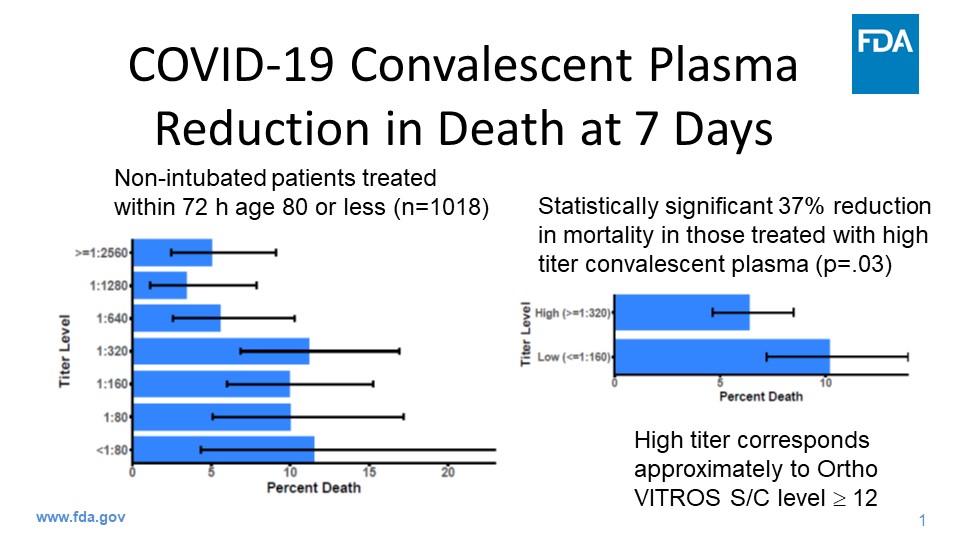
Early in the COVID-19 pandemic, doctors found themselves in a similar situation.  Without an effective drug therapy, many began to use convalescent plasma as an alternative, but unproven treatment for serious disease.  In early April, the U.S. government announced a partnership with the Mayo Clinic to facilitate availability of convalescent plasma to COVID-19 patients in an unprecedented nationwide experimental program.  The project, known as US COVID Plasma, enrolled more than 100,000 patients.  Although it will take years to fully analyze the data collected, initial results are overwhelmingly positive.  In patients with serious COVID-19, the transfusion of convalescent plasma is associated with a 37% reduction in mortality.  On August 23, the FDA announced an emergency use authorization (EUA) for convalescent plasma, making the treatment available to patients not enrolled in a study.  Convalescent plasma has become one of the most important therapies available to treat life-threatening COVID-19.  My colleagues believe it has saved countless lives.  So do I.

Patients who have recovered from COVID-19 can help others who are sick with a simple plasma donation.  In fact, each plasma donation can be divided into four doses, potentially helping four people currently suffering from the disease.  If you have tested positive for SARS-CoV-2, please consider donating at your local blood center.  You’ll be someone’s hero.

Categories
2020 COVID-19 Testing

Antibody Tests

There is no test for COVID-19.  Instead, testing focuses on detection of SARS-CoV-2, the virus known to cause COVID-19 or the body’s response to infection.  Today we will discuss antibody tests, the blood tests used to detect past infections.

Part of a healthy immune response to infection by any virus is the formation of antibodies.  Antibodies are made in plasma cells, a special type of lymphocyte, in response to an assault by a foreign pathogen such as a virus.  The immune response is amazing.  Once plasma cells “learn” how to identify the virus, they crank out millions of these little molecules which coat the surface of the virus, flagging them as “enemy”, and directing other cells of the immune system to isolate and eliminate them.  Once the infection is cleared, the plasma cells “remember” the code for that virus so they can be quickly recruited to make more antibody if the same infection occurs in the future.  This memory eliminates the time-consuming “learning” step.  This simple process explains why most people only get chickenpox once and explains how vaccines can protect children from mumps and measles. 

The first antibodies produced after infection are known as IgM Antibodies.  These are large pentamers, basically 5 antibody units brought together like a snowflake.  IgM antibody production is replaced with IgG antibody production generally after about a week, but the time varies by individual and virus.  IgG antibodies are produced for weeks to years after infection, again depending on the individual and the virus.  Other antibodies are produced by the immune system, but IgM and IgG are most useful in viral serology.  These antibodies are found in the blood stream, so a simple blood test can detect a variety of antibodies, including antibodies to SARS-CoV-2.  It is thought that antibodies to SARS-CoV-2 is what makes convalescent plasma an effective treatment for severe COVID-19.

There are several facts to keep in mind when interpreting antibody test results.  First, antibody tests tell us about past infections, not active infections.  Second, the antibody form tells us whether the infection was recent or distant.  IgM antibodies are made first but go away, so detection of IgM antibodies means the infection was recent.  IgG antibodies are made last but stay around for a long time.  Detection of IgG without IgM means that the infection occurred in the more distant past, at least three weeks ago, and detection of both IgG and IgM means the infection occurred in the transition period.

Antibody tests use an immunoassay methodology, which basically uses antibodies to detect antibodies.  Many of these tests have good specificity and sensitivity, but they are not perfect.  Cross reactivity and interfering substances can cause false positive and false negative results in the best of circumstances.  But we are not in the best of circumstances.  All SARS-CoV-2 antibody tests are available in the U.S. by an emergency use agreement (EUA) with the FDA.  Rigorous studies demanded by the FDA approval process have not yet occurred.

So, if you are positive for SARS-CoV-2 antibody, will you always be?  Don’t know.  If you are positive for SARS-CoV-2 antibody are you immune to COVID?  Don’t know.  It is simply too soon to define the body’s usual response to infection and its implication for future infection.  

What can we learn from antibody tests?  If your antibody test is positive, you probably had a SARS-CoV-2 infection in the past, even if you do not remember being sick.  If you do not have symptoms, and you have not been around someone with COVID-19, then you are not likely to have a current infection.  Continue normal activities, but with vigilant precautions.  Wear a mask and social distance.  These precautions reduce the spread of the disease.

Categories
2020 COVID-19 Testing

Antigen Tests

Elon Musk recently tweeted that he was tested four times in the same day.  Two tests were positive, and two tests were negative.  How can this be? 

Mr. Musk was tested with the BD Veritor Plus rapid antigen test for SARS-CoV-2.  BD Veritor is one of several SARS-CoV-2 antigen tests made available in the United States by an Emergency Use Authorization (EUA) with the FDA.  While PCR tests have some limitations, antigen tests are fraught with many more challenges that bring their results into question.  

First the good news.  Antigen tests are cheap, plentiful, and rapid, usually providing results in 15 minutes or less.  And, with one exception, all antigen tests can be performed in laboratories operating under a CLIA Certificate of Waiver, meaning that they can be performed by personnel with very little education in laboratory science.

So what’s the bad news?  I see three major problems with antigen tests: the test process, the lack of amplification, and poor sensitivity.

The antigen tests from different vendors all follow, with minor variations, the same process.  A sample is collected on a swab, usually from the back of the nose (nasopharynx), and the swab is placed in an incubation well on the test device.  A few drops of reagent containing antibodies against the target (in this case, the SARS-CoV-2 virus capsule) are added.  If the antibodies bind to the target, a signal is sent to the test system.  This signal is usually a color change.  The whole process is very much like a home urine pregnancy test.  

Well, what could go wrong with that?  Strong lines are easy to see, but what about faint lines?  Where is the cut-off between positive and negative?  Some vendors include a reader calibrated to take the guesswork out of reading results, but you begin to see the problem.  The test system introduces an element of subjectivity and operator technique that varies from tester to tester, and these variations impact test results.  Recall that most of these tests are intended to be performed by personnel with very little training in laboratory medicine.  

This process lacks the amplification step of PCR.  That means when the swab is scraped against the back of the nose, what rubs off is all that you have for the test.  If you happened to not scrap off enough virus in an infected person, too bad—the test will be negative.

And that brings me to the final problem with antigen tests: low sensitivity.  According to the FDA submissions by BD, the antigen test used on Mr. Musk has a sensitivity that may be as low as 67%.  What does that mean?  Sensitivity of 67% means that one out of every three infected patients tests negative with the system. That’s right: wrong answers one-third of the time! And that is in the best of circumstances, using data that the manufacturer chose to submit to the FDA. These tests are not always used in the best of circumstances; remember, the test is approved for use by personnel with very little education in laboratory science.

BD makes the following statement in its submission to the FDA: “Negative test results do not preclude infection and should not be used as the sole basis for treatment or other patient management decisions, including infection control decisions, particularly in the presence of clinical signs and symptoms consistent with COVID-19, or in those who have been in contact with the virus. It is recommended that these results be confirmed by a molecular testing method, if necessary, for patient management.” Mr. Musk’s experience is not surprising.

My colleague says she has a Magic 8Ball on her desk that is a lot like an antigen test: it’s cheap, plentiful and rapid. And, she says, it gives about as many correct answers. I agree.

Categories
2020 COVID-19

COVID-19 Penetrance

Why do some people become seriously ill and even die after infection by SARS-CoV-2 and other people have no symptoms at all?  Why do some infected people get COVID-19 and others do not?  These are vexing questions that do not have satisfying answers.  We will learn much about COVID and the virus that causes it in coming months and years, but today we will consider what is currently known about the penetrance of COVID-19.

Penetrance is a medical term used to describe the relationship between the number of people with a disease and the number of people with the condition causing that disease.  If most people with the condition develop disease, the disease has high penetrance.  Incomplete penetrance is the term used to account for the fact that not everybody with a condition suffers from the disease caused by that condition.  Although these terms have roots in clinical genetics, we may apply these concepts to viral infections.  For example, without treatment, most people infected by HIV develops AIDS, but only 30% of people infected by the Hepatitis B Virus (HBV) develop acute hepatitis.  (Of course, I must add that with current anti-retroviral therapy, many fewer people with HIV infection develop AIDS.)  We can say that among people infected by the causative virus, AIDS has higher penetrance than Hepatitis B.  I am sure any number of researchers who can tell you why this is.  I cannot.  But I can tell you that it happens.

In the case of COVID-19, it seems that penetrance is relatively low.  In fact, according to the CDC’s best estimates, the rate of asymptomatic infections is about 40%, meaning that COVID-19 penetrance is about 60%.  But that is an overall rate for all patients.  Can we identify who is at higher risk for disease after infection?

Although we cannot accurately predict which individuals will get severe disease after infection, we can identify populations who are at greater risk.  For example, advanced age is clearly associated with risk of severe disease, and, therefore, higher penetrance.  Using the best CDC estimates, about one in twenty infected people over 70 dies of disease, compared with one in 200 aged 50-69, one in 5,000 adults 20-49, and one in 35,000 young people under 20.

There are other conditions that predict serious symptoms after infection.  Obesity, diabetes, COPD, heart disease, pregnancy, cancer, sickle cell disease, high blood pressure, smoking and immunodeficiency are all associated with more severe disease, and therefore, higher disease penetrance.  But it’s not just the elderly or chronically ill who get sick; young, healthy individuals can and do get seriously ill.  Even if you are in a group that has a low disease penetrance, if you get seriously ill, the penetrance for you is 100%.

Because there are still so many unknowns, it is more prudent to avoid infection than “get it over with.”  Wear your mask in public, avoid social gatherings, and keep your distance.  Stay safe, and help keep others safe too.

Categories
2020 COVID-19 Testing

What Do Test Results Mean?

We want a test to tell us whether someone has COVID-19, but that test does not exist.  Instead, laboratory tests look for the presence of SARS-CoV-2, the virus known to cause COVID-19.  A positive test does not necessarily mean that someone has COVID-19 and a negative test does not always mean that someone does not have COVID-19.  How can this be?  And if this is true, what is all the fuss about testing?

Let me be clear.  Testing is the most important tool available to determine who has COVID-19 and who does not.  But it is not quite as simple as “positive” equals COVID-19 and “negative” does not.  At least not quite.  The test must be interpreted, and to do so, a few simple nuances must be considered.

The most reliable test uses PCR methodology, which includes both amplification and detection steps, making it highly sensitive and specific for the detection of virus.

A negative PCR test means that an individual is not currently infected and has not been recently.  But a negative PCR test cannot be used to predict the future.  In other words, a negative test last week does not prove someone is virus-free today.  Instead, a negative test simply tells us the last time a person was known to be negative for virus.  The significance of a negative test result diminishes rapidly as the collection time fades into the past.  

A positive PCR test means that the person tested is or has been infected by the virus.  If the individual is also symptomatic, we can say the person has COVID-19.  That patient is also infectious (i.e., can spread the virus to others), and should be considered infectious for at least ten days after the first positive test, or for 24-hours after symptoms resolve, whichever is longer.

Our best understanding is that a person does not need to have COVID-19 to spread the virus to others.  Most people test positive five to seven days after exposure, but they can infect others for ten days from time of exposure, longer in exceptional cases.  That is why a person is considered infectious and instructed to quarantine for at least ten days after the first positive test, even without symptoms.  A PCR test may continue to be positive for weeks to months after infection, making it impossible to know whether asymptomatic people with a first-time positive test are newly infected or were infected in the past.  Because we cannot know when the person became infected, the asymptomatic individual should be considered infectious for at least ten days after the first positive test.

Another consequence of the persistence of positive PCR tests after the infection has cleared is that there is no need to require a negative test to prove an individual is no longer infectious.  After the appropriate amount of time has passed since the first positive test and/or resolution of symptoms, an asymptomatic individual should be considered virus-free for at least three months

If you may have been exposed, when should you test?  A test for SARS-CoV-2 becomes positive 2 to 14 days after infection, with most patients turning positive five to seven days later.  Most authorities suggest testing no earlier than five days after possible exposure, unless you have symptoms earlier.  But if you have to wait five days, should you even test at all? Whether you test or not may be a decision that addresses your peace of mind more than anything else.  The most important thing you can do if you think you may have been exposed is to self-quarantine for two weeks.  That is how you keep others safe and stop the virus spread.